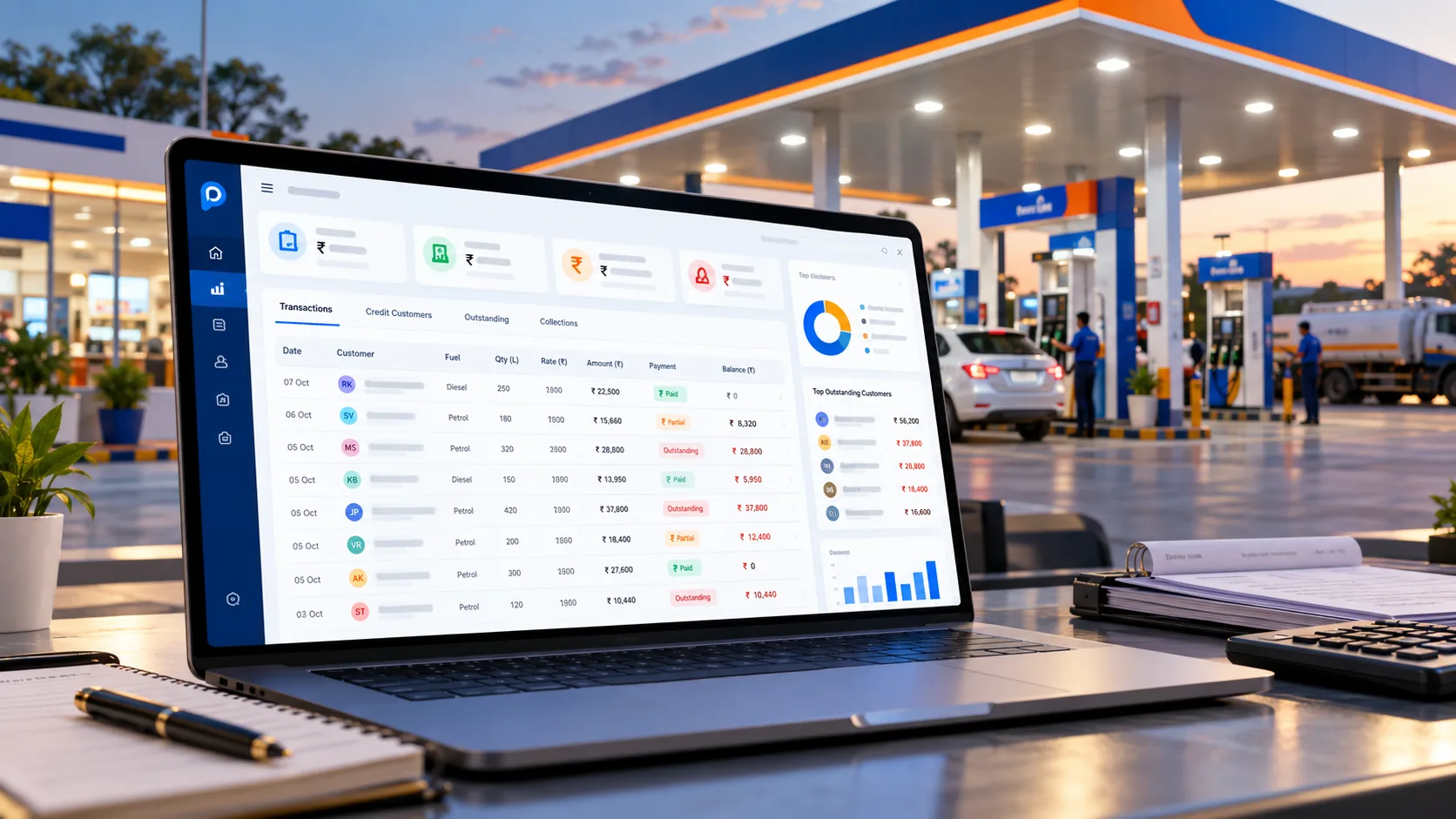
Why Petrol Pump Accounting Is Nothing Like Normal Shop Accounting
A petrol pump is not a normal retail business. A garment shop sells 100 shirts a day at a fixed price and collects the money on the spot. A fuel station sells 10,000–30,000 litres a day, at a retail price that changes daily, in a mix of cash, UPI, card, and — the dangerous one — credit.
That makes fuel station accounting a strange hybrid of three businesses running at the same counter:
- A high-volume retail shop — thousands of nozzle transactions per shift across MS (petrol) and HSD (diesel).
- A lending business — transport fleets, earthmovers, and local companies buy litres today and pay 15, 30, sometimes 90 days later.
- An inventory business — every litre must be traced from tanker receipt to tank dip to nozzle meter, with measurable losses at each step.
Normal accounting software built for shops and offices cannot handle this combination. A general ledger app knows nothing about nozzle meter readings, tank dips, testing quantities, or density corrections. This is exactly why a dedicated petrol pump accounting software exists — and why dealers who track everything in loose registers or spreadsheets eventually lose money they never knew they had.
If you currently run your petrol pump accounts on spreadsheets, start with our petrol pump Excel sheet format guide first — then read this to see where Excel stops and software must take over.
The Five Registers Behind Every Petrol Pump’s Accounts
Ask any experienced dealer and they will tell you: the pump doesn’t run on fuel, it runs on registers. Whether maintained in paper, Excel, or software, these five records are your petrol pump accounting system:
| # | Register | What It Tracks | Updated |
|---|---|---|---|
| 1 | Daily Sales Register (DSR) | Nozzle opening/closing meters, testing qty, rate, shift-wise sales | Every shift |
| 2 | Fuel Stock Register | Tank dips, tanker receipts, stock variance, dip-to-litre conversion | Daily |
| 3 | Cash Book / Day Book | All cash, card, UPI collections, expenses, bank deposits | Daily |
| 4 | Customer Ledger | Party-wise credit sales, payments, and running balance | Every credit txn |
| 5 | Outstanding & Collection Summary | Who owes what, how old it is, what was recovered today | Daily |
The traditional fuel station ledger — that thick bound book behind the counter where the cashier writes ” Sharma Transport — 400L diesel — ₹34,800 — paid ₹20,000 — balance ₹2,15,000” — is really the heart of the whole system. Everything else exists to keep that ledger accurate.
Maintaining registers 1 and 2 in Excel works well for small pumps. Our Excel formula guide covers the exact formulas for nozzle sales and dip conversion. Registers 4 and 5 — the credit side — are where manual methods start breaking down.
Petrol Pump Credit Management: The Silent Profit Killer
Here is the uncomfortable math of petrol pump credit management: your margin is roughly ₹2–3 per litre. If a credit customer defaults on ₹2,00,000, you need to sell roughly one lakh litres — several full days of pump output — just to recover that loss. One bad party can wipe out a month of profit.
And credit doesn’t fail loudly. It fails quietly:
- Rate rises inflate old dues. A fleet that bought at ₹94/litre in April sees its outstanding calculated at ₹96 by June — and disputes the difference.
- Entries get “adjusted”. A payment comes in cash, the cashier reduces the balance mentally, nobody writes it down, and the ledger disagrees with the customer’s notebook.
- Ageing goes unnoticed. ₹40,000 that is 8 days old is routine. The same ₹40,000 at 75 days old is usually a problem — but on paper registers, nobody notices until the party stops picking up calls.
- Limits erode silently. A party with a ₹1 lakh limit quietly sits at ₹1.6 lakh because the cashier kept selling to a “good customer”.
Disciplined dealers run credit with four rules:
- A written credit limit per party — and a hard stop at the limit.
- An ageing bucket for every rupee — 0–15, 16–30, 31–60, 60+ days.
- A party statement on demand — the customer’s own notebook vs yours, reconciled in one page.
- A systematic reminder — not an awkward phone call from the owner, but a polite, documented payment reminder with the exact figure attached.
The single highest-return habit in credit management is the same-day reminder: the moment a party crosses its limit or an invoice crosses 30 days, a WhatsApp message with the exact outstanding figure goes out. Dealers using PumpIQ send these automatically — one click per party, with the ledger attached — and typically see recoveries speed up within weeks.
The Petrol Pump Customer Ledger: What a Proper One Must Show
A petrol pump customer ledger is party-wise accounting of every litre and every rupee. Most dealer disputes trace back to a ledger that is missing one of these columns:
| Column | Why It Matters |
|---|---|
| Date & shift | Ties the entry to the exact DSR, so disputes can be verified against nozzle data |
| Litres & rate separately | Rate changes daily — never record only the amount, or old entries can’t be re-verified |
| Credit sale amount | Every billed sale adds to the party’s balance |
| Payment received | With mode (cash / UPI / cheque) and reference |
| Running balance | The number both sides must agree on |
| Days since last payment | Your early-warning signal |
Two features separate a real customer ledger from a notebook:
- Rate-history safety. When the customer says “you billed me ₹94, price was ₹92”, you can open the entry and show the rate that applied on that date. This alone prevents the most common credit argument at every pump.
- Statement generation. Any party, any date range, one printable page — opening balance, transactions, closing balance. Fleets with their own accounts departments ask for this constantly.
The Petrol Pump Outstanding Report: Your Daily Money Map
Your total outstanding is an interest-free loan you have given to your customers — and a petrol pump outstanding report is the statement of that loan. It answers three questions in one screen:
- How much is the pump owed in total? (Party-wise and grand total)
- How old is each rupee? (The ageing buckets)
- Who do I chase today?
A well-structured outstanding report looks like this:
| Party | Total Due | 0–15 days | 16–30 | 31–60 | 60+ days | Last Payment |
|---|---|---|---|---|---|---|
| Sharma Transport | ₹2,15,000 | ₹65,000 | ₹50,000 | ₹1,00,000 | — | 12 days ago |
| Rao Earthmovers | ₹1,42,000 | — | ₹42,000 | ₹60,000 | ₹40,000 | 38 days ago |
| Sri Logistics | ₹86,500 | ₹86,500 | — | — | — | 3 days ago |
| TOTAL | ₹4,43,500 |
The action column writes itself: 0–15 days — normal business. 16–30 — reminder. 31–60 — call the owner personally, consider tightening the limit. 60+ — stop credit, collect in person. The 60+ bucket is your bad-debt nursery; the whole purpose of the report is to make sure nothing quietly moves into it.
Run it every morning. Dealers who look at outstanding weekly are always reacting; dealers who look daily are always ahead.
The Collection Report: Closing the Cash Loop Every Evening
If the outstanding report is the map, the petrol pump collection report is the evening roll-call of money. It reconciles, for each shift:
- Cash collected — counted, tallied against expected, shortage/excess flagged per cashier
- Digital collections — UPI, card, and wallet settlements
- Credit recoveries — payments received against old dues, matched to the correct party ledger
- Credit sales given — new balances created today
The golden check at day-end:
Cash + Digital + Credit Recoveries = Total Shift Sales − New Credit Sales
If that equation doesn’t balance, you know the same evening — not at month-end when the trail is cold. The collection report is also what turns your outstanding report from a stale list into a living document: every recovery recorded here should visibly reduce a party’s ageing bucket the same day.
Paper vs Excel vs Petrol Pump Accounting Software
Each method has a place. The honest comparison:
| Capability | Paper Registers | Excel Sheets | Petrol Pump Accounting Software |
|---|---|---|---|
| Daily sales (DSR) | Manual math, error-prone | Formulas help, break often | Automatic from nozzle readings |
| Customer ledger | Disputes, overwriting | Works, but manual entry | Auto-built from credit sales |
| Outstanding ageing | Never accurate | Recalculated by hand | One click, always current |
| Collection report | Manual tally | Manual tally | Generated per shift |
| Party statements | 30+ min to compile | 15 min of filtering | Instant, printable |
| Payment reminders | Awkward calls | Manual WhatsApp | 1-click automated WhatsApp |
| Rate-change history | Gone in weeks | Buried in rows | Every entry rate-stamped |
| Theft/error detection | Weeks later | Month-end, maybe | Same shift |
| Works offline at pump | Yes | Yes | Yes (good desktop software does) |
| Owner can check remotely | No | Only if file shared | Yes, with cloud backup |
The pattern is consistent: Excel scales to maybe 20–30 credit parties before the manual reconciliation time exceeds the software cost. Beyond that, a dedicated credit customer software pays for itself in recovered hours and recovered rupees.
What to Look for in Petrol Pump Accounting Software (Checklist)
Not all fuel retail tools are built for Indian dealership accounting. Before you buy, demand every item on this list:
- Offline-first desktop app — the pump cannot stop when the internet does
- DSR and accounting in one flow — credit sales from the shift should land in the customer ledger automatically, with no double entry
- Automatic customer ledger with per-entry rate stamping
- Outstanding report with ageing buckets, party-wise, one click
- Collection report per shift with cashier-wise shortage/excess
- 1-click WhatsApp payment reminders with the exact figure and ledger
- Party statements — printable, any date range
- Credit limit warnings at the counter, before the sale is billed
- Automatic backups (cloud) with local data ownership
- India-specific details — GST invoices for credit parties, ₹ formatting, IOCL/BPCL/HPCL dip charts
- Fast enough for shift-end — the cashier should finish DSR + tally in minutes, not an hour
If a tool fails the first item, nothing else matters. If it fails items 2–4, it isn’t petrol pump accounting software — it’s a general accounting app with a fuel sticker on it.
How to Move From Manual Ledgers to Software in One Week
Dealers often delay switching because they imagine a data-entry project. It isn’t, if you do it in this order:
- Day 1 — Set up parties, not history. Enter each credit party with their current balance as the opening balance. You do not need to digitise five years of ledger; you need today’s correct starting point.
- Day 2–3 — Run the DSR only. Let the software handle nozzle readings, dips, and shift settlement while your old ledgers continue in parallel.
- Day 4–5 — Move credit sales in. From this point every credit transaction goes through the software, so the customer ledger builds itself from live data.
- Day 6 — Verify the equation. Cross-check the collection report against your manual tally for the same shift. It should match to the rupee.
- Day 7 — Cut over. Send every 30+ day party a statement from the new system. That first reminder round usually pays for the software.
The dealers who struggle are the ones who try to migrate history first. Start from today; the software’s value comes from tomorrow’s discipline, not yesterday’s archives.
Frequently Asked Questions
What is petrol pump accounting software?
It is software built specifically for fuel station accounting: it generates the daily sales register from nozzle meter readings, maintains party-wise customer ledgers with daily rate history, produces outstanding and collection reports automatically, and handles credit recovery workflows like payment reminders. General accounting tools (Tally-style) record money after the fact; petrol pump software captures it at the nozzle and the counter, where it is created.
How do petrol pumps track credit customers?
Through a customer ledger maintained party-wise: every credit sale adds litres, rate, and amount; every payment reduces the running balance. Good practice adds a credit limit per party and ageing buckets (0–15, 16–30, 31–60, 60+ days) reviewed daily. Software automates all of it and adds WhatsApp reminders and instant statements.
What is an outstanding report in a petrol pump?
A party-wise list of all unpaid dues, grouped by how old each due is. It shows total receivables, which parties to follow up today, and which balances are drifting toward bad debt. It is the most important daily report for any dealer who sells on credit.
Can Excel work as petrol pump accounting software?
For a small pump with few credit parties, yes — our Excel format guide shows how far it goes. But ledgers, ageing, statements, and reminders all need manual updating in Excel, and one formula error can silently corrupt balances. Most dealers hit the wall somewhere between 20–30 credit parties or two cashiers.
How much does petrol pump accounting software cost?
Modern Indian options are subscription-based and cost a fraction of what one defaulted credit party can wipe out. PumpIQ offers a free 7-day trial with no credit card, so you can measure the time saved before paying anything.
Final Word: Let Software Do the Chasing
Petrol pump accounting has always been three jobs in one — retailer, lender, and stockkeeper. The dealers who grow are not the ones working harder on their registers; they are the ones whose registers work by themselves.
This is exactly why we built PumpIQ — desktop petrol pump accounting software made for Indian fuel stations (IOCL, BPCL, HPCL, Nayara, Jio-bp and more):
- DSR in under 3 minutes — nozzle readings in, complete daily sales report out, shift-wise
- Customer ledgers that build themselves — every credit sale auto-posted with rate history
- Outstanding report with ageing — party-wise, updated live, one click
- Collection reports per shift — cash/digital/credit reconciliation with shortage alerts
- 1-click WhatsApp payment reminders — polite, documented, with exact figures
- Offline desktop app with Google Drive backup — your data stays yours
- Free tank-dip charts built in for accurate stock reconciliation
The whole credit cycle — sell, ledger, age, remind, collect, reconcile — runs without a single manual entry or awkward phone call.
Try the free 7-day trial of PumpIQ — no credit card needed. Bring one week of your real data, run it in parallel with your current register, and see which ledger you trust more on day seven.
Related guides: Complete Petrol Pump Software Guide · Petrol Pump Excel Sheet Format · How Fuel Prices Are Calculated in India