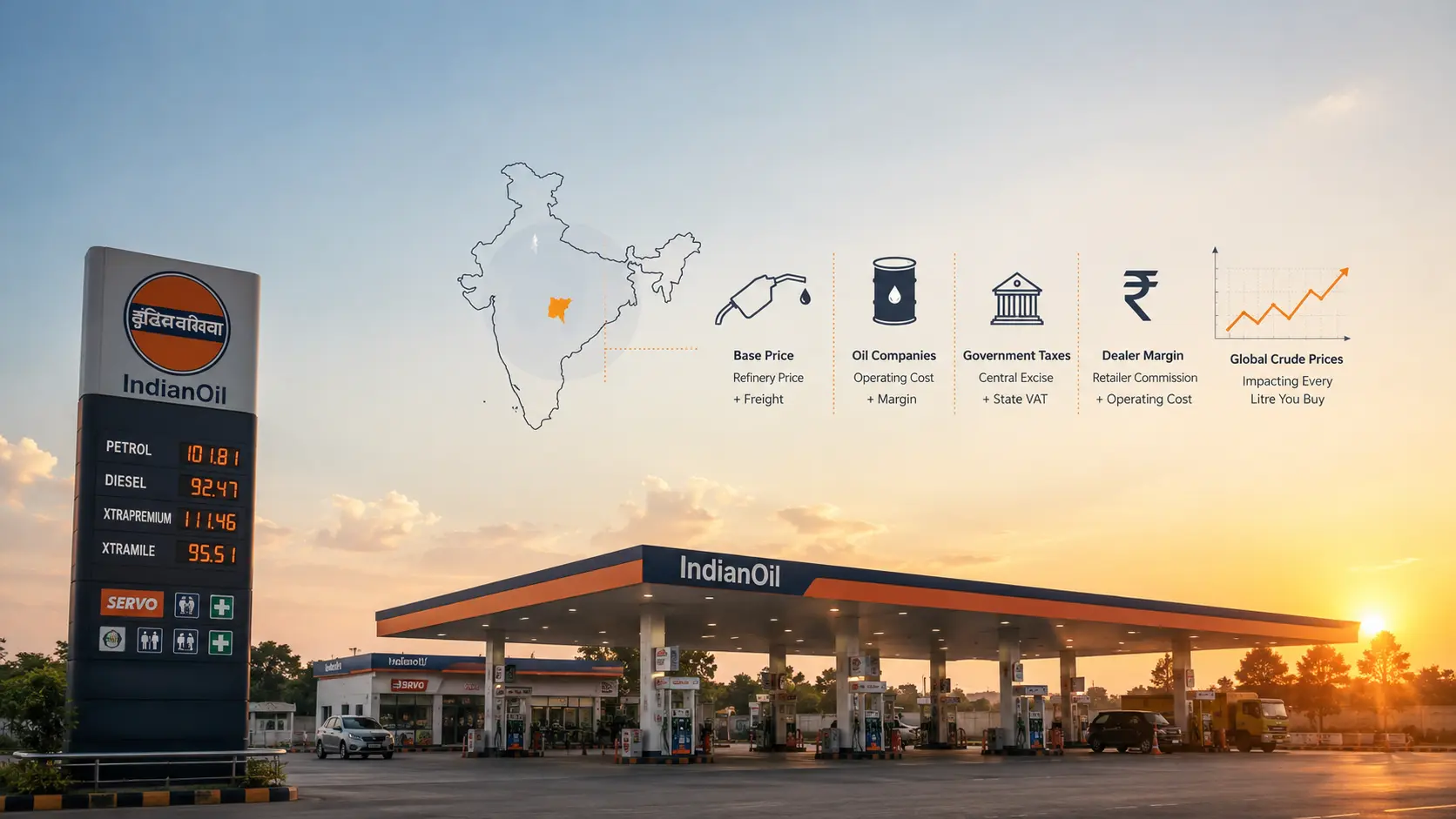
Have you ever wondered why the price of petrol and diesel changes so frequently in India? As a petrol pump owner, understanding these fluctuations isn’t just a matter of curiosity—it’s critical for managing your inventory, predicting cash flow, and avoiding billing errors.
In this comprehensive 2026 guide, we’ll break down exactly how fuel prices are calculated in India, the factors that drive daily revisions, and how modern fuel stations manage these constant changes.
Fuel prices in India have been deregulated, meaning Oil Marketing Companies (OMCs) like IOCL, BPCL, and HPCL revise prices daily based on international crude oil prices and foreign exchange rates.
The Journey from Crude to the Pump
To understand the final retail price of fuel, we need to trace its journey from international markets to your vehicle’s tank. India imports over 80% of its crude oil requirements, making international factors the primary driver of domestic fuel costs.
The calculation of fuel prices involves several distinct components:
- Global Crude Oil Price & Freight
- Refinery Transfer Price (RTP)
- OMC Margins and Freight Costs
- Central Excise Duty
- Dealer Commission
- State Value Added Tax (VAT)
Let’s explore each component in detail.
1. Global Crude Oil Price (The Indian Basket)
The starting point for fuel pricing is the cost of unrefined crude oil. India uses a specific benchmark called the Indian Basket of Crude Oil, which is a weighted average of Oman/Dubai sour grade and Brent sweet grade crude.
Since international oil is traded in US Dollars, the USD to INR exchange rate plays a massive role. If crude prices drop but the Rupee weakens against the Dollar, the cost of importing oil may remain high.
2. Refinery Transfer Price (RTP)
Once crude oil reaches India, it goes to refineries. The RTP is the price at which refineries sell the processed products (petrol and diesel) to the Oil Marketing Companies (OMCs). This price includes: - The cost of crude oil - Freight charges to bring crude to India - Customs duties - Refinery processing margins
3. OMC Margins and Freight
OMCs (IOCL, BPCL, HPCL) incur costs to transport the refined fuel from refineries to their depots across the country. They also add a small profit margin at this stage.
4. Central Excise Duty
This is a fixed tax levied by the Central Government. Unlike VAT, which is a percentage of the price, excise duty is typically a flat rate per litre.
Because excise duty is a flat rate, a drop in international crude oil prices does not automatically result in a proportional drop in the retail price. The government often adjusts excise duty to manage fiscal deficits.
5. Dealer Commission
This is the margin earned by you—the petrol pump dealer. It covers your operational costs (electricity, staff salaries, infrastructure) and provides a profit. The dealer commission is periodically revised by OMCs in consultation with dealer associations.
6. State Value Added Tax (VAT)
Finally, each State Government levies its own VAT or Sales Tax on the fuel. Because VAT is calculated as a percentage of the total accumulated price (including the dealer commission and excise duty), fuel prices vary significantly from state to state.
For example, VAT in Maharashtra is historically higher than in states like Delhi or Haryana, resulting in higher retail prices for consumers in Mumbai.
Example: The Mathematics of Fuel Pricing
Let’s look at a simplified, hypothetical breakdown of how a liter of petrol is priced in Delhi (prices are illustrative for 2026):
| Component | Cost per Litre (₹) |
|---|---|
| Base Price (RTP + OMC Margin + Freight) | 52.50 |
| Central Excise Duty | 19.90 |
| Dealer Commission | 3.80 |
| State VAT (e.g., 19.4% on (Base + Excise + Commission)) | 14.78 |
| Final Retail Price | 90.98 |
(Note: Actual figures vary daily based on OMC notifications and state-specific tax policies.)
Why Do Prices Change Daily?
In June 2017, India shifted from a fortnightly price revision system to Dynamic Fuel Pricing (daily price revisions).
The Logic Behind Daily Revisions
Before dynamic pricing, OMCs would absorb the volatility of crude prices for 15 days, which often resulted in sudden, massive price hikes (or cuts) that shocked the market. Daily revisions ensure that variations in global crude prices and currency exchange rates are immediately passed on to the consumer in smaller, more manageable increments.
Prices are revised every day at 06:00 AM.
Challenges for Petrol Pump Owners
While daily pricing benefits the broader economy by preventing sudden shocks, it creates significant operational headaches for petrol pump owners:
- Updating Dispensing Units (DUs) manually every morning.
- Updating the billing software to reflect the new price exactly at 6 AM.
- Reconciling inventory value (which changes every day).
- Managing customer disputes if prices change while they are in the queue.
Failure to update prices accurately can lead to severe financial losses. If you sell 5,000 liters of diesel at the old price after a ₹1 price hike, you immediately lose ₹5,000 in revenue.
How PumpIQ Solves the Daily Pricing Challenge
Managing daily price changes manually is an outdated and error-prone process. This is where modern petrol pump management software like PumpIQ becomes essential.
1. Automated Price Updates
With PumpIQ, you don’t need to manually calculate or update prices across multiple systems. You simply enter the new OMC price into the PumpIQ dashboard, and the system automatically updates: - Your Daily Sales Record (DSR) - Your billing and invoicing modules - Your inventory valuation
2. Error-Free Billing for Credit Customers
Credit customers (B2B clients) are usually billed based on the fuel price on the exact date of dispensing. PumpIQ automatically applies the correct historical price to every transaction, ensuring your credit bills are 100% accurate.
3. Real-Time Inventory Valuation
Because fuel is a commodity whose value changes daily, knowing your exact inventory worth is crucial for accounting. PumpIQ provides real-time valuations, calculating the exact value of the fuel sitting in your underground tanks based on the day’s current price.
Pro Tip: Use PumpIQ's automated reporting to instantly see how a price hike or cut affected your overall margin for the month.
Frequently Asked Questions (FAQs)
Q: Who decides the final price of petrol and diesel? A: The base price is determined by OMCs based on international crude prices and exchange rates. However, Central and State governments heavily influence the final retail price through Excise Duty and VAT.
Q: Why is fuel cheaper in some states and expensive in others? A: Because State VAT varies. States with lower VAT (like Haryana or Delhi) generally have cheaper fuel compared to states with higher VAT (like Maharashtra or Rajasthan).
Q: Do petrol pump dealers lose money when prices drop? A: Yes, if a dealer has a full underground tank (stock purchased at a higher price) and the retail price drops the next morning, they suffer an inventory loss. Conversely, they gain when prices rise.
Q: How can I ensure my billing system is always using the correct daily price? A: By using automated software like PumpIQ. It synchronizes your pricing across all operational modules, eliminating manual entry errors.
Conclusion
Understanding the mechanics of fuel pricing in India empowers petrol pump owners to make better operational decisions. While you cannot control global crude prices or government taxes, you can control how efficiently your station adapts to these changes.
By leveraging automated systems like PumpIQ, you can eliminate the stress of 6 AM price revisions, prevent billing errors, and focus on what truly matters: growing your business and serving your customers better.
Ready to simplify your petrol pump operations? Explore PumpIQ’s Features Today.